NEMA 14-50 Outlet Installation in Ocala, FL
Your panel gets checked before you get a number, permits are filed with the job, and the price is fixed before any tool comes out.
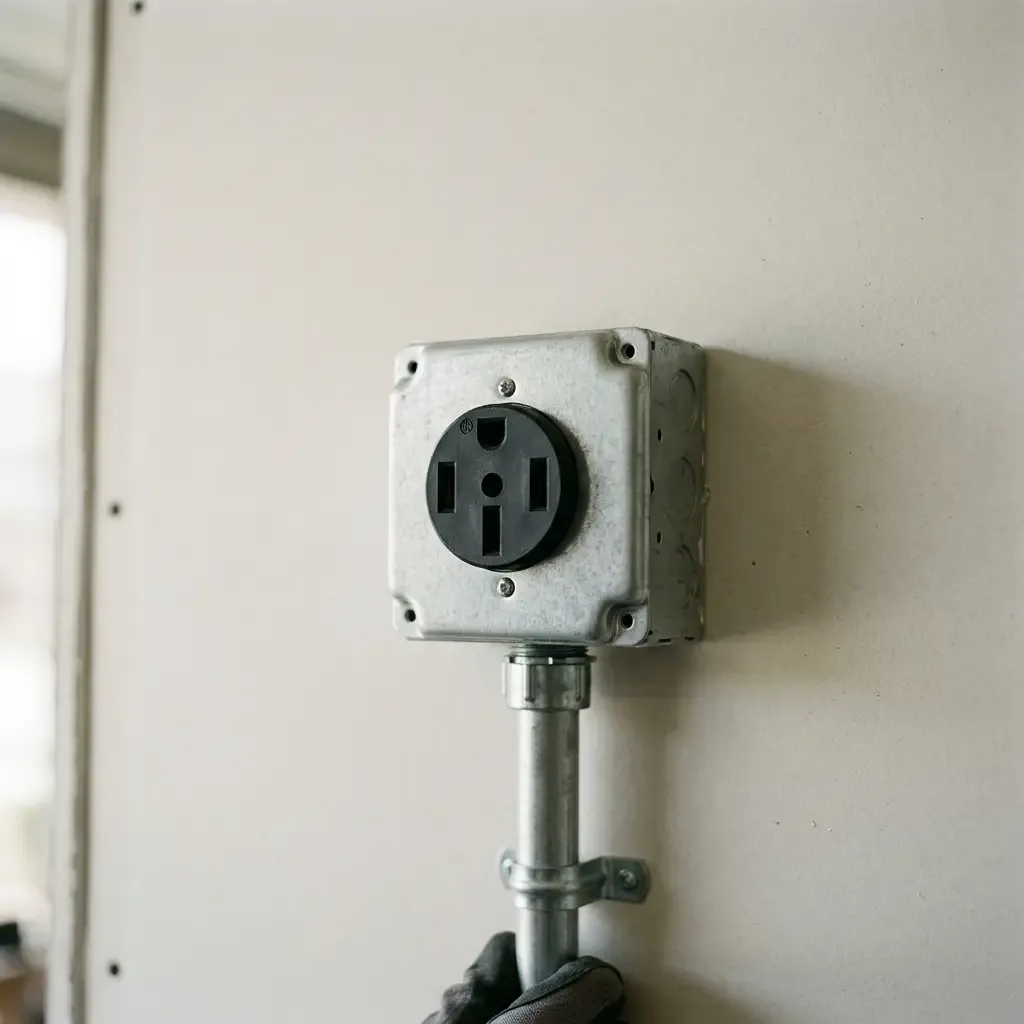
What is a NEMA 14-50 outlet, and why do EV owners want one?
A NEMA 14-50 is a 240-volt, 50-amp outlet, the same style used for RVs and electric ranges, that lets you plug in a mobile connector or a portable Level 2 charger instead of hardwiring a fixed unit.
It's the plug-in path, as opposed to the hardwired default most Level 2 installs use. Same voltage, same basic wiring, different way of connecting the charger.
Hardwired vs. Plug-In: Which Is Actually Better for an EV Charger?
An outlet is faster and cheaper to install than a hardwired charger, and it lets you take the charger with you or swap brands later without touching the wiring again.
A hardwired unit is generally the better call outdoors, though. There's no plug connection to loosen, arc or corrode after years of daily plug-and-unplug cycles and Florida humidity, and some manufacturers specify a hardwired connection for their charger's full-rate warranty.
Code adds a real wrinkle here too. NEC Article 210.8(F) requires GFCI protection on outdoor 240-volt receptacles rated 50 amps or less, and a 14-50 falls squarely in that category. That's not optional trim. It's a breaker or outlet-level GFCI device added to the job, and it's worth knowing before you assume an outlet install is simply cheaper across the board.
What's Included in a NEMA 14-50 Outlet Install?
- Dedicated 50-amp outletWired on its own circuit, not shared with an existing range or RV outlet already on the property.
- GFCI protection where code requires itAdded for outdoor installs per NEC 210.8(F); confirmed during the site visit for garage locations too.
- Weatherproof in-use coverRated to stay closed with a cord plugged in, for any outdoor or exposed mounting location.
- Panel capacity checkSame load calculation as a hardwired install. The outlet doesn't skip this step.
- Permit filedSubmitted before install day, for Ocala city limits or unincorporated Marion County addresses alike.
- Final test under loadOutlet voltage and connection confirmed before the electrician leaves.
How Does the Outlet Installation Work?
- 1
Quote and panel review
Same panel check as any Level 2 install, since a 14-50 still draws up to 40 amps continuous.
Time on site: same day to 48 hours
- 2
Permit filed
Filed with the correct building department for your address.
Time on site: typically a few business days in Marion County
- 3
Install day
Circuit run, outlet mounted, GFCI added if the location requires it, tested under load.
Time on site: 2 to 5 hours
- 4
Inspection
Scheduled once the local inspector's calendar allows.
Time on site: usually within a week or two
Where you landA dedicated outlet ready for a portable Level 2 charger or mobile connector, permit closed out.
What Does a NEMA 14-50 Install Cost in Ocala, FL?
USD
- Indoor garage outlet, near panel$500–$1,000per installBaseline scenario; no GFCI-in-use cover needed indoors in most cases.
- Outdoor or exposed outlet$650–$1,300per installAdds GFCI protection required by code for outdoor 240V receptacles, plus a weatherproof cover.
- Detached-garage run to a 14-50 outlet$1,700–$5,200per installSame trenching and conduit factors as any detached run. See the detached-garage page.
- Panel-upgrade add-on$1,700–$4,200add-onOnly if the load calculation shows the panel's out of room.
These are typical Ocala metro ranges, not a quote. Your exact price is confirmed in writing after the panel's actually checked.
When a NEMA 14-50 Outlet Is the Wrong Call
Skip the outlet if the mount location gets direct rain without real cover. Even a rated cover doesn't fully offset years of humidity at the plug connection. Some chargers also require a hardwired connection for their full-rate warranty. Check the fine print before assuming an outlet is the cheaper, no-downside choice.
NEMA 14-50 Outlet Installation in Ocala, FL — questions
Same physical plug style, yes: 240 volts, 50 amps. But it should be on its own dedicated circuit for an EV charger, not shared with an existing range or RV outlet, since two loads on one circuit will trip the breaker or worse under sustained charging draw.
Yes, that's the point of choosing an outlet over hardwiring. Once it's installed, permitted and inspected, plugging in a mobile connector or portable Level 2 charger is a normal household task, not electrical work.
Yes, with GFCI protection and a rated weatherproof in-use cover, both required by code for an outdoor 240-volt outlet like a 14-50. Without those, or in a spot that gets direct rain with no real cover, we'd steer you toward hardwiring instead.
Usually, yes, for a comparable near-panel install: roughly $500 to $1,300 for an outlet versus $700 to $1,700 for hardwiring. That gap narrows or disappears once GFCI protection, a weatherproof cover, or a longer run are added to the outlet job.
Yes, that's the main advantage of a plug-in setup. The outlet stays with the house, but a portable charger or mobile connector unplugs and goes with you, unlike a hardwired unit that's part of the home's fixed wiring.
Licensed EV charger installation for Ocala and Marion County. Panel checked before you're quoted a price.
- Licensed & insuredEV charger circuits are electrical work performed under a real electrical contractor license, not a specialty license of their own.
- Panel checked firstYour panel's actual spare capacity is checked before you're quoted a price, not assumed from its age or amperage label.
- Permitted and inspectedThe permit gets filed and the inspection scheduled as part of the job, not left for you to chase down.
- Fixed price before work startsYou see the number in writing before any tool touches your panel.
Get a fast, fixed quote
Tell us your vehicle, your panel's age or amperage if you know it, and where you want the charger mounted. A written estimate follows, usually within a business day.
Let's do it
Let's get you charging.
Tell us where you want the outlet mounted and whether it's exposed to weather, and we'll price the GFCI requirement into the quote up front.